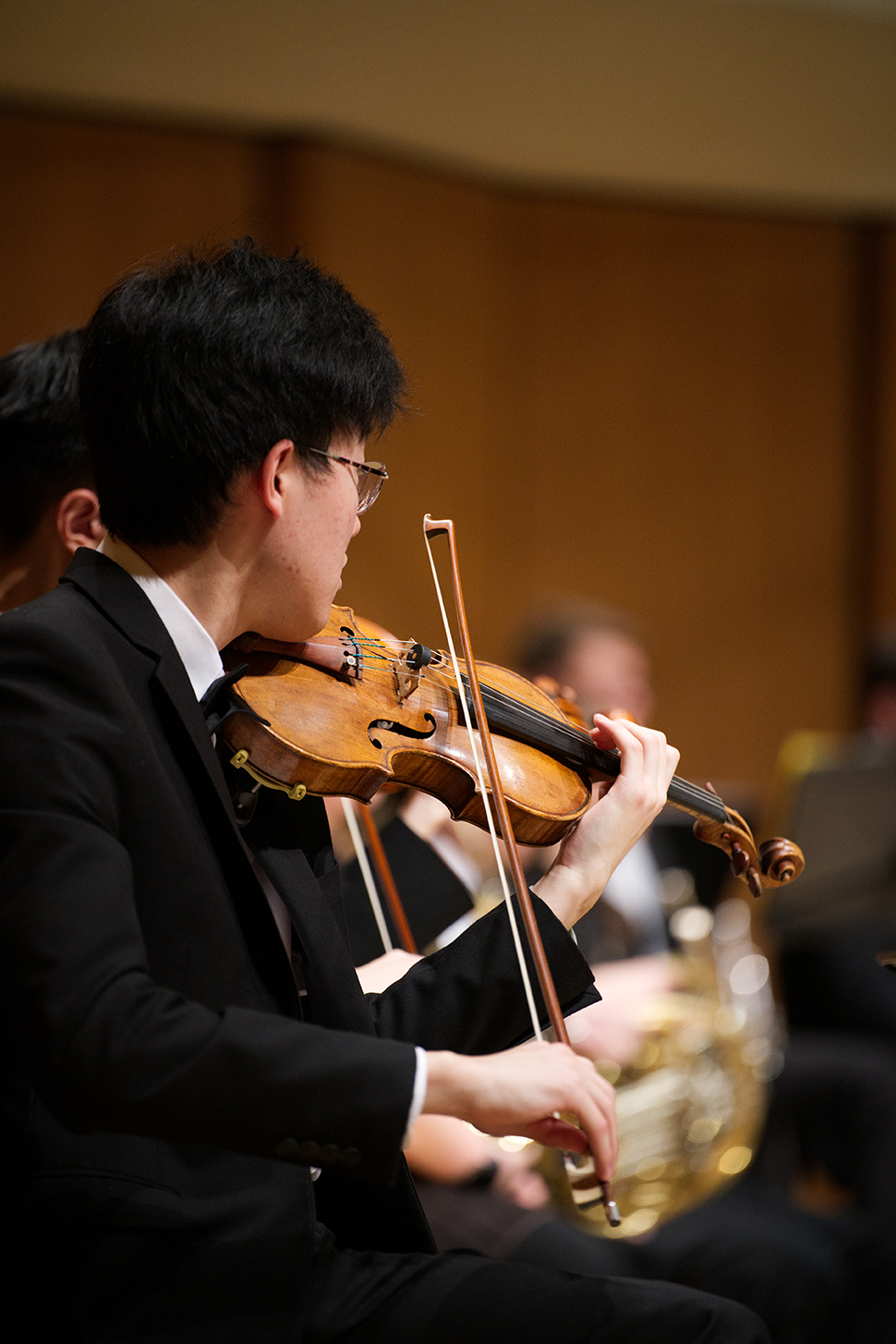
Jinjoo Cho and Guests
Unearthing Love and Grief in George Rochberg's Third String Quartet
Friday, March 13, 2026 at 7:30pm CDT
Galvin Recital Hall
Pre-concert conversation, 6:30 p.m.
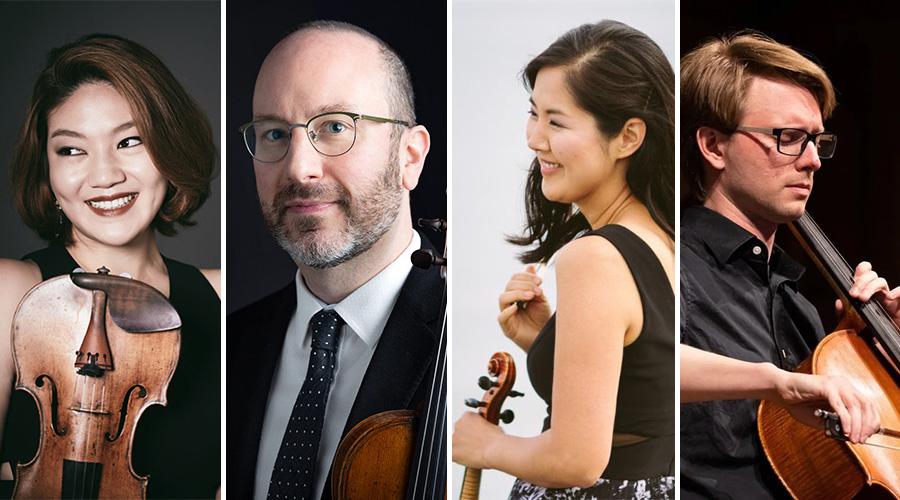
Jinjoo Cho and David Bowlin, violin; Min-Jeong Koh, viola; Max Geissler, cello
Bienen School associate professor of violin Jinjoo Cho and special guests present a powerful recital culminating a week-long colloquium devoted to 20th-century American composer George Rochberg, titled Unearthing Love and Grief in George Rochberg’s Third String Quartet. The event highlights the dramatic and deeply personal transformation in Rochberg’s musical voice following the loss of his teenage son—a shift that ignited spirited debate across the musical world.
Internationally acclaimed for her expressive artistry and a top prizewinner in major competitions, Jinjoo Cho has performed at Carnegie Hall’s Stern Auditorium, the Aspen Music Festival, the Banff Centre, and with leading orchestras including the Cleveland Orchestra, Orchestre symphonique de Montréal, Deutsche Radio Philharmonic, and Seoul Philharmonic. For this special performance, she is joined by violinist David Bowlin (Eastman School of Music), violist Min-Jeong Koh (The Glenn Gould School at The Royal Conservatory), and cellist Max Geissler (Butler University/Latitude 49) to present a compelling program of works by Anton Webern and George Rochberg.
Anton Webern, Langsamer Satz
George Rochberg, String Quartet No. 3
Tickets are $8 for the general public and $5 for students with valid lD.
Sold OutPre-concert Conversation
The evening opens with a pre-concert conversation featuring musicologists Amy Wlodarski (Dickinson College)—author of George Rochberg, American Composer—and Ryan Dohoney (Northwestern University), along with renowned cellist Norman Fischer (Rice University). Rochberg’s Third String Quartet, written for and premiered by Fischer’s ensemble, the Concord String Quartet, stands as one of Rochberg’s most significant and personal works. Fischer’s lifelong friendship and close collaboration with the composer during its creation offer audiences an unusually intimate perspective on its history, meaning, and legacy.
Pre-concert Speakers
Amy Wlodarski
See Full BioAn award-winning scholar and teacher, Prof. Wlodarski researches the complex expressive relationships between Jewish music, trauma, memory, and the tragedies of World War II and the Holocaust. Her two monographs—Musical Witness and Holocaust Representation (2015) and George Rochberg, American Composer (2019)—have both received accolades from leading musicological societies. In addition to written scholarship, Prof. Wlodarski regularly presents programs for major musical institutions, including the Los Angeles Opera, the Philadelphia Orchestra, the New York Philharmonic, and the Violins of Hope Exhibition, and her work has been supported by the Fulbright Commission, the National Endowment for the Humanities, and Harvard University. As an educator, she specializes in courses that explore the aesthetics, ethics, and politics of creative practices in music ranging from 1750 to the present and conducts the Dickinson College Choir. Prof. Wlodarski was selected as 2024 Guggenheim Fellow. During her fellowship year, she wrote a history of the international reception of Viktor Ullmann's Der Kaiser von Atlantis, a chamber opera written in Ghetto Terezín in 1944.
Ryan Dohoney
See Full BioPHD, COLUMBIA UNIVERSITY
Associate Dean for Faculty. I am a scholar of U.S. and European modernism and experimentalism in the twentieth and twenty-first centuries. My research documents the relationships produced by musical performance and artistic collaboration within interdisciplinary artistic communities. I draw upon insights from ethnomusicology, microhistory, affect theory, religious studies, and phenomenology and combine these interdisciplinary methods with rigorous archival research.
My work has explored matters of music, collectivity, and friendship through the artistic world of Morton Feldman (1926–1987), a central figure of postwar musical modernism. My first monograph, Saving Abstraction: Morton Feldman, the de Menils, and the Rothko Chapel (Oxford, 2019), takes on the conflicted history of Morton Feldman’s most important collaboration—his work with Dominique and John de Menil on music for the Rothko Chapel in Houston. The book is a microhistorical analysis of the premiere of Morton Feldman’s music for the Rothko Chapel in Houston on April 9, 1972. In it, I reconstruct the network of artists, musicians, and patrons who collaborated on the event: composer Feldman, painter Mark Rothko, violist Karen Philips, and the patrons Dominique and John de Menil. These collaborators struggled over fundamental questions about the emotional efficacy of artistic practice and its potential translation into religious feeling. At the center of this study is the question of ecumenism—that is, in what terms can religious encounters be staged for fruitful dialog to take place? This was a dilemma for Feldman, whose music sought to produce sublime “abstract experience,” as well as the de Menils, who envisioned the Rothko Chapel as a space for ritual intervention into late modernity. I develop two central concepts in the book: abstract ecumenism and agonistic universalism. Abstract ecumenism characterizes a broad spiritual orientation within postwar musical modernism and experimentalism that aspired to altered states of ego-loss This offered a renewed religious sensibility achieved through artistic practice. Agonistic universalism describes the particular religious form that Feldman’s music achieves both within Rothko Chapel. It is an ascetic mode of existence that endures with hope the aporia of postwar modernization’s destructiveness and modernism’s failure to effectively counter it.
The research and writing on this book were supported by a number of awards from the Paul Sacher Foundation, the American Council of Learned Societies, the American Philosophical Society, and a Faculty Research Grant from the Graduate School at Northwestern.
My second monograph, Morton Feldman: Friendship and Mourning in the New York Avant-Garde, is expected in 2021 from Bloomsbury and will consist of expanded versions of four previously published essays on Feldman’s relationships with John Cage, Merle Marsicano, Frank O’Hara, Earle Brown and Charlotte Moorman. It will feature a new chapter on Feldman’s troubled friendship with painter Philip Guston. I also contribute a wide-ranging methodological introduction on modernism and the historiography of friendship and mourning. Intimate bonds produced more than an “underlying network of awareness” that painter Robert Motherwell intuited as the glue holding together the New York avant-garde; friendship itself is the answer to his question of “what exactly constitutes the basis of our community?” To show this, I position Feldman as a relational center of a social word and advocate for scholarly attention to the affective and epistemological conditions of friendship. I show how poems, films, compositions, and recordings register the tensions and attachments of this community.
Beyond my writing on Feldman and his world, I have written on the life and music of Julius Eastman as well as essays in music and philosophy. I am currently involved in long-term ethnographic work on the experimental music community Wandelweiser.
I advise a wide range of PhD students and am particularly interested to work with researchers investigating musical modernism (broadly construed), experimental music, music philosophy, LGBTQ topics, critical race studies, and science/technology studies. I work closely with my students to develop both research and professional skills and am particularly keen to help them develop non-pathological writing habits. My advisees’ current research includes experimental music as interpretive labor, the re-mediation of U.S. musicals from film to radio, the affects and semiotics of Japanese popular music, the soundscapes of spiritualism and early media technology, and transatlantic networks of gay modernists and their intimate publics.
In addition to my work in Bienen’s music studies department, I work closely with the Institute for New Music and am affiliated faculty with the interdisciplinary clusters in Critical Theory, Global Avant-Garde and Modernist Studies, and Gender and Sexuality Studies.
Norman Fischer
See Full BioNorman Fischer has concertized on five continents and in 49 of the 50 United States. He was the cellist with the Concord String Quartet through its 16-year career and winner of the Naumburg Chamber Music Award, two Grammy nominations, and an Emmy Award. In over 1000 concerts, the quartet performed 18 Bartók cycles, 36 Beethoven cycles, and premiered 50 works. They also recorded 40 works for RCA Red Seal, Vox, Nonesuch, and CRI. Mr. Fischer’s chamber music expertise has led to performances with the American, Audubon, Bair, Cavani, Chester, Chiara, Ciompi, Cleveland, Dover, Ensø, Emerson, Jasper, Juilliard, Mendelssohn, and Schoenberg string quartets, Santa Fe Chamber Music Festival, Banff, Chamber Music International, Context (including a complete Beethoven piano trio cycle on period instruments), and Houston’s Da Camera Society. He has also served on many competition juries, including the Paolo Borciani and Banff International String Quartet competitions.
Mr. Fischer is the cellist with the Fischer Duo, a group with pianist Jeanne Kierman that was founded in 1971 and specializes in the classical masterworks of Beethoven, Brahms, and Schumann as well as music of our own time. They have over a dozen recordings. Most notable are: Imaginées: Music of French Masters, American Music in the 1990s, Complete Music for Cello and Piano of Chopin and Liszt, and Complete Cello Music of William Bolcom. The most recent album is Beethoven Cello and Piano Complete on the Centaur label, the most comprehensive collection of Beethoven’s music for the two instruments. The Duo has premiered over 30 new scores by composers such as George Rochberg, Augusta Read Thomas, Robert Sirota, Pierre Jalbert, and Richard Wilson. They continue to actively perform throughout the United States and twice have served as Artistic Ambassadors for the USIA with tours to South America and South Africa.
Mr. Fischer continues to be committed to music for solo cello. His 1983 New York solo debut of the Bach Six Suites in one evening was hailed by New York Times critic John Rockwell as “inspiring.” During the 1994 season, Mr. Fischer’s recording of William Bolcom’s unaccompanied cello score was featured on Broadway as incidental music for Arthur Miller’s most recent play, Broken Glass. Mr. Fischer was honored by being invited to open the 1995 Tanglewood Music Center season with a performance of Henri Dutilleux’s Trois Strophes sur le nom Sacher, and during the 1996 Tanglewood season was similarly honored in presenting the world premiere of Mr. Bolcom’s Suite in C Minor He has performed the standard concerto classics with conductors such as Lukas Foss, Robert Spano, Larry Rachleff, and Efrain Guigui. He has also championed new works for the genre, such as the Robert Sirota Cello Concerto (Tanglewood 1985), the Augusta Read Thomas Vigil (Cleveland Chamber Symphony, recorded on the GM label), Steven Stucky Voyages (recorded for Opus One in 1991), and Ross Lee Finney’s Narrative (with the Cleveland Chamber Symphony, recorded for New World Records).
Mr. Fischer is currently Herbert S. Autrey Professor of Cello and Director of Chamber Music at the Shepherd School of Music at Rice University in Houston. Before accepting this position in 1992, he held positions at Dartmouth College and the Oberlin Conservatory of Music. Mr. Fischer also holds the Charles E. Culpepper Foundation Master Teacher Chair at the Tanglewood Music Center, where he has been on the summer faculty since 1985. He is currently on the board of directors of Chamber Music America.
Amy Wlodarski
CloseAn award-winning scholar and teacher, Prof. Wlodarski researches the complex expressive relationships between Jewish music, trauma, memory, and the tragedies of World War II and the Holocaust. Her two monographs—Musical Witness and Holocaust Representation (2015) and George Rochberg, American Composer (2019)—have both received accolades from leading musicological societies. In addition to written scholarship, Prof. Wlodarski regularly presents programs for major musical institutions, including the Los Angeles Opera, the Philadelphia Orchestra, the New York Philharmonic, and the Violins of Hope Exhibition, and her work has been supported by the Fulbright Commission, the National Endowment for the Humanities, and Harvard University. As an educator, she specializes in courses that explore the aesthetics, ethics, and politics of creative practices in music ranging from 1750 to the present and conducts the Dickinson College Choir. Prof. Wlodarski was selected as 2024 Guggenheim Fellow. During her fellowship year, she wrote a history of the international reception of Viktor Ullmann's Der Kaiser von Atlantis, a chamber opera written in Ghetto Terezín in 1944.
Ryan Dohoney
ClosePHD, COLUMBIA UNIVERSITY
Associate Dean for Faculty. I am a scholar of U.S. and European modernism and experimentalism in the twentieth and twenty-first centuries. My research documents the relationships produced by musical performance and artistic collaboration within interdisciplinary artistic communities. I draw upon insights from ethnomusicology, microhistory, affect theory, religious studies, and phenomenology and combine these interdisciplinary methods with rigorous archival research.
My work has explored matters of music, collectivity, and friendship through the artistic world of Morton Feldman (1926–1987), a central figure of postwar musical modernism. My first monograph, Saving Abstraction: Morton Feldman, the de Menils, and the Rothko Chapel (Oxford, 2019), takes on the conflicted history of Morton Feldman’s most important collaboration—his work with Dominique and John de Menil on music for the Rothko Chapel in Houston. The book is a microhistorical analysis of the premiere of Morton Feldman’s music for the Rothko Chapel in Houston on April 9, 1972. In it, I reconstruct the network of artists, musicians, and patrons who collaborated on the event: composer Feldman, painter Mark Rothko, violist Karen Philips, and the patrons Dominique and John de Menil. These collaborators struggled over fundamental questions about the emotional efficacy of artistic practice and its potential translation into religious feeling. At the center of this study is the question of ecumenism—that is, in what terms can religious encounters be staged for fruitful dialog to take place? This was a dilemma for Feldman, whose music sought to produce sublime “abstract experience,” as well as the de Menils, who envisioned the Rothko Chapel as a space for ritual intervention into late modernity. I develop two central concepts in the book: abstract ecumenism and agonistic universalism. Abstract ecumenism characterizes a broad spiritual orientation within postwar musical modernism and experimentalism that aspired to altered states of ego-loss This offered a renewed religious sensibility achieved through artistic practice. Agonistic universalism describes the particular religious form that Feldman’s music achieves both within Rothko Chapel. It is an ascetic mode of existence that endures with hope the aporia of postwar modernization’s destructiveness and modernism’s failure to effectively counter it.
The research and writing on this book were supported by a number of awards from the Paul Sacher Foundation, the American Council of Learned Societies, the American Philosophical Society, and a Faculty Research Grant from the Graduate School at Northwestern.
My second monograph, Morton Feldman: Friendship and Mourning in the New York Avant-Garde, is expected in 2021 from Bloomsbury and will consist of expanded versions of four previously published essays on Feldman’s relationships with John Cage, Merle Marsicano, Frank O’Hara, Earle Brown and Charlotte Moorman. It will feature a new chapter on Feldman’s troubled friendship with painter Philip Guston. I also contribute a wide-ranging methodological introduction on modernism and the historiography of friendship and mourning. Intimate bonds produced more than an “underlying network of awareness” that painter Robert Motherwell intuited as the glue holding together the New York avant-garde; friendship itself is the answer to his question of “what exactly constitutes the basis of our community?” To show this, I position Feldman as a relational center of a social word and advocate for scholarly attention to the affective and epistemological conditions of friendship. I show how poems, films, compositions, and recordings register the tensions and attachments of this community.
Beyond my writing on Feldman and his world, I have written on the life and music of Julius Eastman as well as essays in music and philosophy. I am currently involved in long-term ethnographic work on the experimental music community Wandelweiser.
I advise a wide range of PhD students and am particularly interested to work with researchers investigating musical modernism (broadly construed), experimental music, music philosophy, LGBTQ topics, critical race studies, and science/technology studies. I work closely with my students to develop both research and professional skills and am particularly keen to help them develop non-pathological writing habits. My advisees’ current research includes experimental music as interpretive labor, the re-mediation of U.S. musicals from film to radio, the affects and semiotics of Japanese popular music, the soundscapes of spiritualism and early media technology, and transatlantic networks of gay modernists and their intimate publics.
In addition to my work in Bienen’s music studies department, I work closely with the Institute for New Music and am affiliated faculty with the interdisciplinary clusters in Critical Theory, Global Avant-Garde and Modernist Studies, and Gender and Sexuality Studies.
Norman Fischer
CloseNorman Fischer has concertized on five continents and in 49 of the 50 United States. He was the cellist with the Concord String Quartet through its 16-year career and winner of the Naumburg Chamber Music Award, two Grammy nominations, and an Emmy Award. In over 1000 concerts, the quartet performed 18 Bartók cycles, 36 Beethoven cycles, and premiered 50 works. They also recorded 40 works for RCA Red Seal, Vox, Nonesuch, and CRI. Mr. Fischer’s chamber music expertise has led to performances with the American, Audubon, Bair, Cavani, Chester, Chiara, Ciompi, Cleveland, Dover, Ensø, Emerson, Jasper, Juilliard, Mendelssohn, and Schoenberg string quartets, Santa Fe Chamber Music Festival, Banff, Chamber Music International, Context (including a complete Beethoven piano trio cycle on period instruments), and Houston’s Da Camera Society. He has also served on many competition juries, including the Paolo Borciani and Banff International String Quartet competitions.
Mr. Fischer is the cellist with the Fischer Duo, a group with pianist Jeanne Kierman that was founded in 1971 and specializes in the classical masterworks of Beethoven, Brahms, and Schumann as well as music of our own time. They have over a dozen recordings. Most notable are: Imaginées: Music of French Masters, American Music in the 1990s, Complete Music for Cello and Piano of Chopin and Liszt, and Complete Cello Music of William Bolcom. The most recent album is Beethoven Cello and Piano Complete on the Centaur label, the most comprehensive collection of Beethoven’s music for the two instruments. The Duo has premiered over 30 new scores by composers such as George Rochberg, Augusta Read Thomas, Robert Sirota, Pierre Jalbert, and Richard Wilson. They continue to actively perform throughout the United States and twice have served as Artistic Ambassadors for the USIA with tours to South America and South Africa.
Mr. Fischer continues to be committed to music for solo cello. His 1983 New York solo debut of the Bach Six Suites in one evening was hailed by New York Times critic John Rockwell as “inspiring.” During the 1994 season, Mr. Fischer’s recording of William Bolcom’s unaccompanied cello score was featured on Broadway as incidental music for Arthur Miller’s most recent play, Broken Glass. Mr. Fischer was honored by being invited to open the 1995 Tanglewood Music Center season with a performance of Henri Dutilleux’s Trois Strophes sur le nom Sacher, and during the 1996 Tanglewood season was similarly honored in presenting the world premiere of Mr. Bolcom’s Suite in C Minor He has performed the standard concerto classics with conductors such as Lukas Foss, Robert Spano, Larry Rachleff, and Efrain Guigui. He has also championed new works for the genre, such as the Robert Sirota Cello Concerto (Tanglewood 1985), the Augusta Read Thomas Vigil (Cleveland Chamber Symphony, recorded on the GM label), Steven Stucky Voyages (recorded for Opus One in 1991), and Ross Lee Finney’s Narrative (with the Cleveland Chamber Symphony, recorded for New World Records).
Mr. Fischer is currently Herbert S. Autrey Professor of Cello and Director of Chamber Music at the Shepherd School of Music at Rice University in Houston. Before accepting this position in 1992, he held positions at Dartmouth College and the Oberlin Conservatory of Music. Mr. Fischer also holds the Charles E. Culpepper Foundation Master Teacher Chair at the Tanglewood Music Center, where he has been on the summer faculty since 1985. He is currently on the board of directors of Chamber Music America.
Mary B. Galvin Recital Hall
Address
70 Arts Circle Drive
Evanston, IL 60208
United States
About
Located in the Ryan Center for the Musical Arts, this 400-seat hall features a 40-foot glass wall offering views of Lake Michigan and the Chicago skyline. Undulating walls of Forest Stewardship Council–certified wood, covered with a thin layer of African moabi wood, provide optimal acoustics, and the hall is equipped with state-of-the-art sound and video equipment for recording.